Two ways of being a developer in the age of AI
Continuing my experiments with Generative AI (the last post can be read here, where I show what I thought of a personal project: updating my legacy code from 2011), I would like to talk a little about how this is affecting me personally, and about what I see happening to developers these days (keep in mind these are 100% my own opinions, ok?).
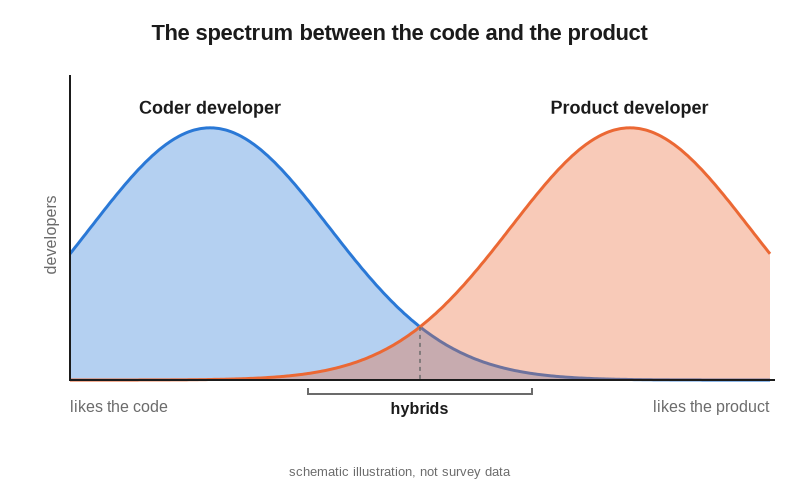
I like to say that the act of developing is changing. It is not dying, but it is changing, and regardless of that, I believe there will always be two poles, far apart from each other:
- The developer who does what they do because they like creating code, where the problem is not what matters, but its solution is.
- The developer who likes creating products, where the code is not what matters, but the end result is.
These two poles lead to completely different profiles, but both are necessary. Placing developers in one pole or the other is very hard, and I believe there is a spectrum between them, more and more clearly defined.
The developer who likes creating code
Here we are talking about the developer, sometimes already of a certain age, who likes to understand how a machine works, who understands what an algorithm is and what happens behind it. I am talking about developers who not only know the famous Q_rsqrt, but also recognize its formula and understand how it works. Out of curiosity, the formula is this:
Here and reinterpret the same 32-bit pattern as an integer and as a floating point number, without converting the value. The first term is the initial approximation obtained by shifting the exponent, and the second is one Newton-Raphson step. This was done by id Software in the Quake III code, where it is used in many places, mainly in the way the lighting was used at the time. Today this kind of code is no longer the best option, but remember we are talking about 1999; at the time it was revolutionary (thank you, Greg Walsh). And it is an algorithm from the 80s!
This kind of developer can also use Generative AI to code, without fear or hesitation, but they are the kind that will usually arrive with the code already written and will spend tokens only to:
- optimize the code
- make it more secure
- write documentation
- find holes in the algorithms
- improve the code/architecture in general
It is the kind of developer who would never write code without knowing which language to write it in, nor in a language they have not mastered. They bring the problem into their world and expand their world with every problem. They would never write a prompt like:
Build me a website, I don't care about the language, but it has to run on a machine with 2 GB of RAM, have a database, Google SSO and it needs the following features:
This kind of developer will always need to exist, and not only in the AI field (or who do you think is currently responsible for improving AIs?), but everywhere. It is this developer’s studies, the knowledge gained over years of research and of making the machine do what they want it to do, that will keep making their products better. And not only their products: if they are into Open Source, they will help other people become more and more critical, more and more skilled.
The only real problem with this today is time. Products made by this kind of developer usually take a while to see the light of day, which tends to be a problem in a world where, if you sleep for 2 months, you are already obsolete. I see this profile a lot in more “core” deliveries: architecture foundations, kernels, engines, systems that cannot fail, etc. These are products that can take a bit longer, since what is expected of them is:
- Stability
- Performance
- Maintainability
- Explainability
And this kind of code usually has plenty of that.
The developer who likes creating products
This other profile is the one showing up the most nowadays: for them AI tools are not optional, they are their company. They start from the idea that AI tools made them their own CEO, that every developer is a startup from day 1, and that every new release is a new event. This is not bad, quite the opposite. Who has never had that million-dollar idea that never left the drawing board for lack of time and ability to build it? Or even the small ideas, which would be useful but do not justify spending 1 week building a system?
Without AI tools, these things would be impossible to do. At this point, I think what matters is:
- How good is your prompt?
- How much control are you willing to give up to have a product?
There are tools made 100% with Generative AI, by a developer or architect who knows what they are doing, that are good, secure, stable and deliver very good value to whoever uses the system. There are not many, but they exist, and that is proof that this profile matters. More importantly, the developer will specialize in other things. For them it does not matter what Q_rsqrt is; what matters is understanding the architecture of what they are building, whether there are points of failure in the system, whether they chose the right technology for the project, whether the bugs that exist are easy to fix, whether the code can be explained, and whether it solves the original problem correctly.
Once these points are studied, the sky is the limit for this developer. The biggest advantage here is time: the time saved building a system this way is unreal. The biggest disadvantage is how personal the product is. Using Generative AI this way ends up producing a product that solves your problem but has a generic “face”. If they are not careful, it will always end up looking like yet another cryptocurrency investment site, yet another site selling a generic product, etc. And that easily creates a bad stigma around what is being built. If the developer really does not know what they are doing, they will fall into every problem that everyone talks and complains about, for example:
- Layout: However creative you are, have you noticed that sites and apps are all starting to look the same? Well, that is one of the visual problems of having everything made by AI. I am no UI/UX expert, so my apps and sites tend to look like everything else, and that is fine, it is my limitation, but keep an eye on it if it bothers you.
- Complexity: Every architecture is based on microservices, all of it will always need a cloud, and all of it will have at least 4 different layers, with 7 different services… to show a personal site with cooking projects. I have talked about this before, but projects made entirely with Generative AI tend to be ultra complex for simple things. Unless you know what you are doing…
- Security: Of all of them, I think this is the worst part. Everything looking the same, or being too complex for what it needs to do, is somewhat acceptable, but security is where it gets hard. We have had countless cases of API keys sitting in public repositories, bugs that (since everything is more or less the same) can easily be replicated, systems that do not handle memory properly and cause memory leaks; the list could be a whole article (or even a master’s thesis).
Where I fit in
Ok, so where do I fit in? I started developing back around 1995 in C and Assembly (why is another story); moved to C++ in college; built PHP sites (the famous LAMP) in the early 2000s; worked with C#; taught C, C++, Java, data structures, algorithm analysis, classical AI, among other subjects; worked with Python when the ML boom started; built complete infrastructures using only Bash, YAML and Python; among a myriad of other things related to development. How do I use Generative AI for development today?
I consider myself somewhere in the middle. I use it a lot to build quick PoCs that can prove to me whether an idea works or not. If the idea works, I go on in the old-school way of developing, with Generative AI helping me clear up some doubts, do the repetitive part, etc., but I am always the one flying. In rare cases I act more as just an architect and let the AI do everything, but I am always flying it and questioning it, and always, always checking the security of what it is doing.
What about you? Do you think you fit one of these profiles? Do you think there is another one?